The Invisible Ecosystem Crisis
Beneath every footstep across Britain's 17.2 million hectares of agricultural land lies a world more diverse than the Amazon rainforest. Yet decades of intensive farming have rendered much of this underground universe virtually lifeless. Where once a single gram of healthy soil contained billions of bacteria, thousands of fungi, and hundreds of protozoa, many of our fields now harbour little more than compacted earth held together by synthetic fertilisers.
This silent catastrophe extends far beyond agricultural productivity. Healthy soil represents Britain's largest terrestrial carbon store, capable of sequestering atmospheric CO₂ at scales that dwarf our renewable energy achievements. When soil ecosystems collapse, this carbon escapes back into the atmosphere, accelerating the very climate crisis that threatens our food security.
Pioneers of the Underground Revolution
Across England's chalk downs, Scotland's highland valleys, and Wales' pastoral heartlands, a growing cadre of farmers is writing a different story. At Holganset Farm in Devon, fourth-generation farmer James Robertson has transformed 450 hectares from a struggling dairy operation into a thriving regenerative system that hasn't seen a plough in eight years.
"The change is extraordinary," Robertson explains, crumbling rich, dark earth between his fingers. "When we stopped tillage and eliminated synthetic inputs, the soil literally came alive again. We're seeing earthworm populations increase tenfold, and our carbon sequestration rates now exceed 2.5 tonnes per hectare annually."
Similar transformations are unfolding at Grange Farm in Lincolnshire, where the Harrington family has replaced monoculture wheat with diverse cover crop mixtures featuring crimson clover, phacelia, and winter rye. Soil tests reveal mycorrhizal fungi networks have expanded by 400% since the transition began in 2019.
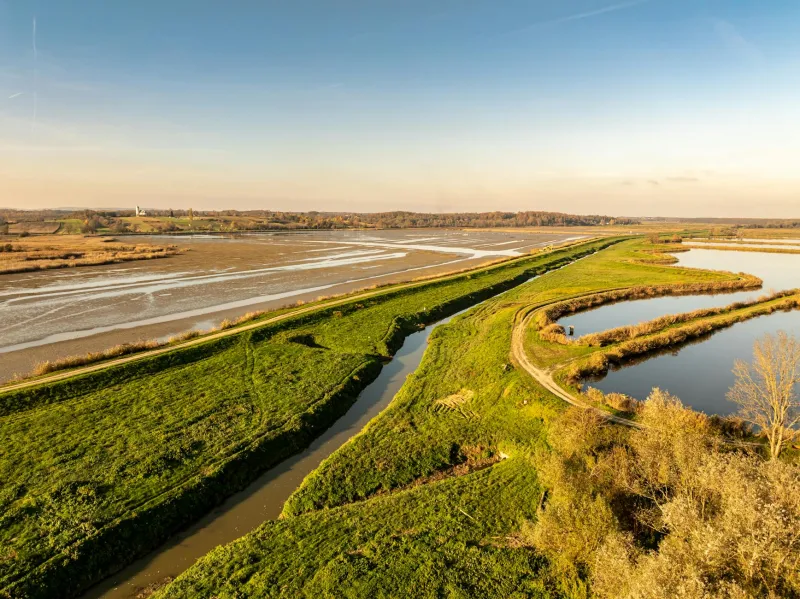
 Photo: Grange Farm, via grangefarmpark.co.uk
The Science Behind the Soil Renaissance
Recent research from Rothamsted Research demonstrates the profound ecological changes occurring beneath regenerative farms. Dr Sarah Mitchell's team has documented how eliminating tillage allows fungal networks to establish complex underground webs that can extend for kilometres, connecting plant roots across entire fields.
These mycorrhizal networks don't merely improve crop nutrition—they fundamentally alter soil chemistry. Fungi produce glomalin, a sticky protein that binds soil particles into stable aggregates, creating the porous structure essential for water infiltration and carbon storage. Traditional ploughing destroys these networks annually, forcing farmers into a cycle of dependency on synthetic inputs to replace natural soil functions.
"We're essentially watching farmers reconstruct entire ecosystems from the ground up," explains Dr Mitchell. "The biodiversity gains are measurable within months, but the carbon sequestration benefits compound annually. Some regenerative farms are now storing carbon faster than native grasslands."
Economic Realities and Market Pressures
Despite mounting scientific evidence, the transition to regenerative agriculture presents formidable economic challenges. Initial yields often decline as soil ecosystems rebuild, creating cash flow pressures for farmers already operating on narrow margins. The three-to-five-year transition period frequently coincides with increased pest pressure and weed competition as natural predator-prey relationships re-establish.
At Westfield Farm in Yorkshire, organic conversion specialist Emma Thompson acknowledges the financial strain: "We lost 20% of our wheat yield in year two, which nearly broke us. But by year four, our input costs had fallen by 60%, and yields recovered to match our previous conventional levels. The soil health improvements were worth the temporary sacrifice."
Government support remains patchy and bureaucratic. While the Environmental Land Management scheme offers payments for carbon sequestration, the application process frequently takes months, and verification requirements often exceed the administrative capacity of smaller farms.
Climate Solutions Hiding in Plain Sight
The climate potential of soil restoration extends far beyond individual farm boundaries. Research by the Carbon Trust suggests that widespread adoption of regenerative practices across British agriculture could sequester 64 million tonnes of CO₂ annually—equivalent to removing 13.8 million cars from our roads.
This represents one of Britain's most accessible climate solutions. Unlike renewable energy infrastructure or carbon capture technology, soil restoration requires no new inventions or massive capital investments. The knowledge exists, proven techniques are documented, and early adopters are demonstrating economic viability.
The Path Forward
The underground renaissance spreading across British farms offers genuine hope for reconciling agricultural productivity with climate action. As soil ecosystems recover, they become more resilient to extreme weather, reducing crop losses from both drought and flooding—critical adaptations as our climate becomes increasingly unpredictable.
Yet scaling this transformation requires coordinated support. Farmers need transition funding, technical assistance, and market premiums that recognise the environmental services regenerative agriculture provides. The microscopic revolution beneath our feet could determine whether British agriculture becomes part of the climate solution or remains trapped as part of the problem.
The choice lies not in distant technologies or future innovations, but in the soil beneath our feet—waiting to be brought back to life.