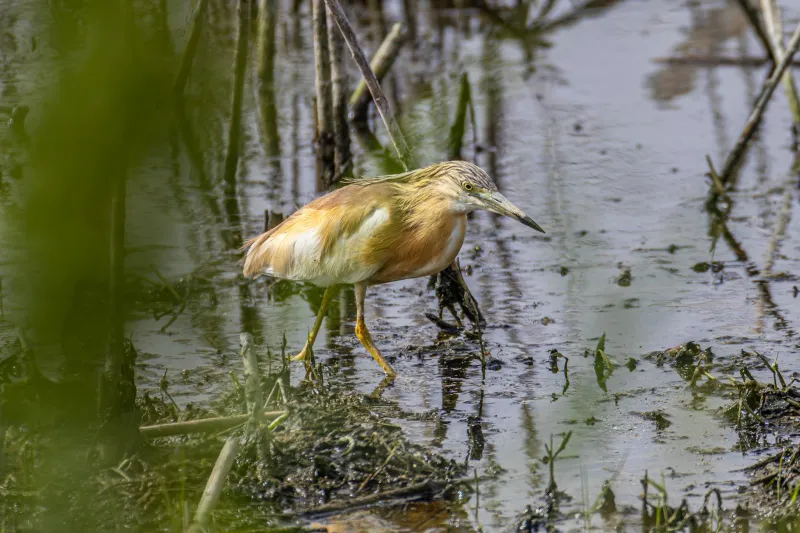
Britain's Phantom Birds: The Bittern's Precarious Recovery Exposes Wetland Vulnerability
The haunting boom of the Eurasian bittern—a sound once thought lost forever from British wetlands—has returned to pierce the morning silence across carefully managed reedbeds from Norfolk to Somerset. Yet this conservation success story, celebrated as one of Britain's most remarkable species recoveries, conceals a troubling reality: our wetland ecosystems remain dangerously vulnerable to the accelerating impacts of climate change.
From the Brink of Extinction
In 1997, just 11 breeding males remained across the entire British Isles—a catastrophic decline from historical populations that once thrived in extensive marshlands before drainage and development decimated their habitat. The bittern, with its cryptic plumage and secretive nature, had become Britain's most elusive bird, teetering on the precipice of national extinction.
The species' near-disappearance reflected broader wetland destruction that saw 90% of Britain's natural marshlands vanish over the past century. Industrial agriculture, urban expansion, and systematic drainage schemes transformed vast reed-fringed waterways into productive farmland, leaving isolated fragments of suitable habitat scattered across the landscape.
Engineering a Recovery
Conservation organisations, led by the Royal Society for the Protection of Birds, launched an unprecedented intervention programme targeting habitat restoration and creation. The strategy focused on establishing extensive reedbeds with optimal water levels, creating fish-rich pools for foraging, and maintaining the delicate balance of vegetation structure that bitterns require for both nesting and hunting.
Minsmere in Suffolk became the blueprint for bittern recovery, with carefully engineered water management systems allowing precise control of seasonal flooding patterns. Similar projects at Leighton Moss, Ham Wall, and Titchwell demonstrated that strategic habitat creation could support breeding populations where natural processes had been disrupted.
By 2019, breeding males had increased to 228 across 80 sites—a twenty-fold increase that represented one of Europe's most successful species recovery programmes. The bittern's distinctive territorial call, absent from British wetlands for decades, once again echoed across restored marshlands.
Climate Vulnerability Exposed
However, recent population fluctuations have exposed the fragility underlying this apparent success. The 2018 drought saw breeding numbers crash as water levels dropped below critical thresholds, whilst the 2020 floods devastated nesting sites across multiple reserves. These extreme weather events, becoming increasingly frequent under climate change, reveal how dependent bittern recovery remains on precise environmental conditions.
Rising temperatures alter the fundamental ecology of reedbed systems. Warmer winters reduce ice formation that traditionally prevented fish kills, but also accelerate reed growth, creating vegetation too dense for bittern foraging. Simultaneously, changing precipitation patterns disrupt the seasonal water level fluctuations essential for maintaining diverse aquatic communities.
The Reedbed Ecosystem Crisis
The bittern's predicament reflects broader pressures on Britain's wetland biodiversity. Reedbeds support specialist communities including harvest mice, bearded tits, and numerous invertebrate species adapted to fluctuating water levels. Climate-driven changes in hydrology threaten to unravel these complex ecological relationships.
Research indicates that many restored sites lack the resilience to withstand prolonged drought or extreme flooding. Artificial water management systems, whilst successful in supporting bittern recovery, may prove inadequate against the magnitude of climatic shifts projected for the coming decades.
Adaptive Conservation Strategies
Conservationists are developing more sophisticated approaches to wetland management that incorporate climate projections and ecosystem resilience. These include creating larger, interconnected habitat networks that allow species movement between sites, and establishing altitudinal gradients that provide refugia during extreme weather events.
Natural flood management techniques, including strategic floodplain restoration, offer opportunities to create dynamic wetland systems more capable of adapting to changing conditions. Projects in the Somerset Levels and the Great Fen demonstrate how landscape-scale interventions can support both biodiversity conservation and climate adaptation.
Lessons for Ecosystem Resilience
The bittern's story illuminates fundamental questions about conservation effectiveness in an era of rapid environmental change. Whilst targeted species recovery programmes can achieve remarkable results, they may prove insufficient without addressing broader ecosystem vulnerability.
Success requires moving beyond single-species management towards landscape-scale approaches that enhance natural resilience. This means accepting that future wetland ecosystems may differ significantly from historical baselines, whilst ensuring they continue supporting the ecological processes essential for biodiversity conservation.
The bittern's haunting call, now heard once again across British wetlands, serves as both celebration of conservation achievement and warning of challenges ahead. Protecting these phantom birds—and the ecosystems they represent—demands adaptation strategies equal to the scale of climatic change they face.