The Invisible Crisis
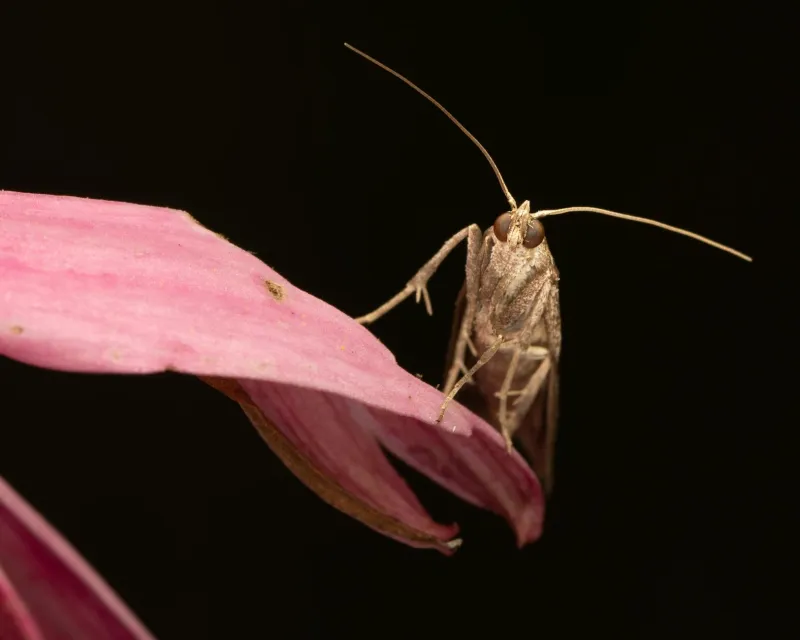
Across Britain's darkening countryside, a silent ecological catastrophe unfolds each night. While conservation headlines focus relentlessly on declining bee populations, an equally vital group of pollinators faces an existential crisis that receives a fraction of the attention it deserves. Moths, the unsung heroes of Britain's nocturnal ecosystem, are vanishing at rates that dwarf even the most alarming bee statistics.
Recent research from Butterfly Conservation reveals that moth abundance has plummeted by 28% since 1968, with some species experiencing declines exceeding 90%. This represents not merely the loss of individual species, but the systematic dismantling of Britain's night-time ecological web—a complex network of relationships that has evolved over millennia.
 Photo: Butterfly Conservation, via butterfly-conservation.org
The Night Shift Economy
Moths constitute one of Britain's most diverse insect groups, with over 2,500 species recorded across the country. These nocturnal specialists have carved out ecological niches that complement, rather than compete with, their butterfly cousins. Where butterflies dominate daylight hours, moths take the night shift, pollinating an array of plants that have evolved specifically to attract nocturnal visitors.
Honeysuckle, evening primrose, and night-scented catchfly release their fragrances after sunset, advertising their nectar rewards to moth visitors. The tobacco hawkmoth, despite its exotic name, plays a crucial role pollinating native petunias and other night-flowering species across southern England. Without these nocturnal partnerships, entire plant communities face reproductive failure.
The ecological services moths provide extend far beyond pollination. As caterpillars, they form the foundation of countless food webs. A single oak tree can support over 300 moth species, whose larvae provide essential protein for breeding birds. Research by ornithologist Professor Dave Goulson demonstrates that areas with declining moth populations show corresponding decreases in insectivorous bird species, creating cascading effects throughout woodland ecosystems.
Artificial Suns and Chemical Shadows
The primary drivers of moth decline paint a sobering picture of human impact on natural systems. Light pollution represents perhaps the most insidious threat, transforming Britain's night-time landscape into a maze of artificial suns that fatally confuse nocturnal insects.
Moths navigate using celestial light sources, maintaining fixed angles to the moon and stars to plot straight-line courses. Street lighting, security floods, and illuminated buildings create false beacons that trap moths in endless spirals around light sources. Exhausted and disoriented, they become easy prey or simply expire from energy depletion.
Dr Helen Baker of the Centre for Ecology & Hydrology estimates that light pollution affects over 60% of Britain's land area, creating ecological dead zones where moths cannot function effectively. The proliferation of LED lighting, while energy-efficient, has exacerbated the problem. LEDs emit blue-rich light spectra that prove particularly attractive to moths, creating more potent ecological traps than traditional sodium lighting.
Simultaneously, intensive agriculture has stripped the countryside of the diverse plant communities moths require. Hedge removal, grassland conversion, and pesticide applications have created vast ecological deserts where once-thriving moth populations struggle to survive. Neonicotinoid pesticides, while banned for outdoor use, persist in the environment and continue to affect non-target species years after application.
Citizen Scientists in the Dark
Despite the scale of the crisis, understanding moth decline relies heavily on a dedicated network of citizen scientists who venture into Britain's darkness armed with mercury vapour traps and ultraviolet lights. The National Moth Recording Scheme, coordinated by Butterfly Conservation, depends on thousands of volunteers who spend summer nights identifying and recording moth species in their gardens and local habitats.
Retired teacher Margaret Hopkins exemplifies this commitment. For over thirty years, she has operated moth traps in her Gloucestershire garden, meticulously recording species composition and abundance. Her data reveals trends invisible to casual observation: the disappearance of once-common species like the garden tiger moth, offset by the arrival of climate migrants from continental Europe.
 Photo: Margaret Hopkins, via images.muchloved.com
"People assume moths are just boring brown things," Hopkins explains, carefully examining a pale tussock moth in her trap. "But they're incredibly diverse and beautiful. Each species tells a story about habitat quality and environmental change."
These volunteer records feed into national databases that inform conservation policy and habitat management decisions. Without this army of dedicated moth-ers, the scale of nocturnal biodiversity loss would remain largely invisible to science and policymaking.
Engineering Hope
Conservation organisations are beginning to develop targeted responses to moth decline. The Royal Society for the Protection of Birds has modified lighting schemes at several reserves, installing moth-friendly amber LEDs and implementing "dark corridors" that allow nocturnal movement between habitats.
Urban initiatives show particular promise. The City of London Corporation has pioneered adaptive lighting systems that dim automatically during peak moth activity periods. Initial results suggest these measures can reduce moth mortality by up to 40% while maintaining human safety requirements.
Rural habitat restoration focuses on recreating the diverse plant communities moths require. Natural England's Environmental Stewardship schemes now include specific prescriptions for moth-friendly management, encouraging farmers to maintain uncultivated margins rich in native wildflowers.
The Darkness We Need
The moth crisis reflects broader challenges facing Britain's wildlife in an increasingly illuminated and intensive landscape. Their decline serves as a canary in the coal mine, warning of ecosystem-wide changes that extend far beyond individual species losses.
Recognising and addressing moth decline requires a fundamental shift in how we perceive and value darkness. Rather than viewing unlit areas as spaces requiring illumination, we must recognise them as essential habitats that support irreplaceable ecological communities.
The future of Britain's nocturnal ecosystem hangs in the balance, dependent on our willingness to embrace the darkness and the remarkable creatures that call it home. In protecting moths, we preserve not just individual species, but the intricate web of relationships that make our night-time landscapes function as living systems rather than sterile, illuminated voids.