The Underwater Plague
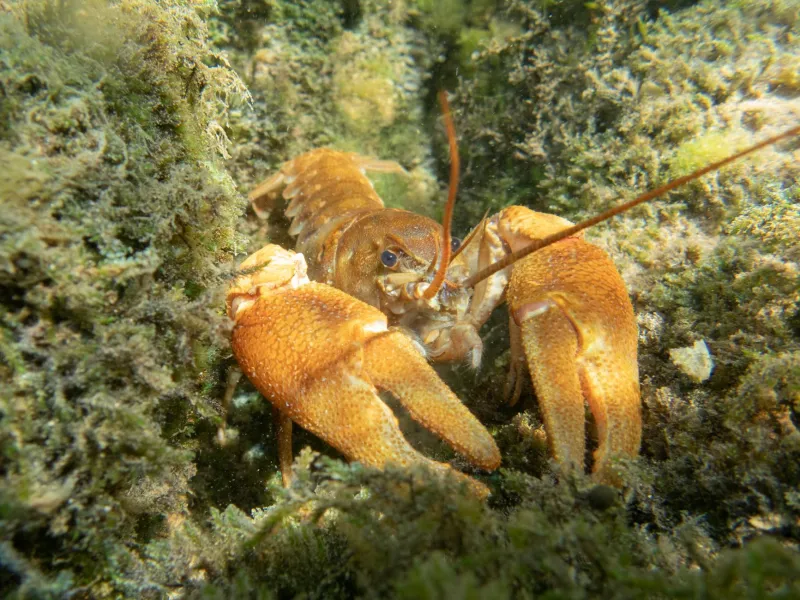
Beneath the tranquil surface of Britain's rivers, an ecological catastrophe unfolds with ruthless precision. American signal crayfish (Pacifastacus leniusculus), introduced to British waters in the 1970s for commercial aquaculture, have transformed from promising imports into Britain's most devastating freshwater invaders. These armoured crustaceans now occupy virtually every river system across England and Wales, their relentless expansion representing one of the most comprehensive biological invasions in British ecological history.
The scale of their conquest defies comprehension. From the chalk streams of Hampshire to the upland rivers of Yorkshire, signal crayfish populations have exploded beyond all projections, with some waterways supporting densities exceeding 20 individuals per square metre. Their presence marks the beginning of the end for entire freshwater communities that evolved over millennia without such aggressive competition.
Native Casualties of an Aquatic War
Britain's white-clawed crayfish (Austropotamobius pallipes), our only indigenous freshwater crustacean, faces systematic annihilation. Once abundant across British rivers, these gentle natives now cling to existence in fewer than 400 isolated populations, primarily confined to remote Welsh valleys and Scottish highlands where signal crayfish have yet to penetrate.
The mechanisms of destruction operate on multiple fronts. Signal crayfish carry crayfish plague (Aphanomyces astaci), a devastating fungal pathogen that proves invariably fatal to white-clawed populations whilst leaving the American invaders completely unaffected. This biological weapon spreads through spores that survive in water for weeks, creating invisible death zones that native crayfish cannot detect until infection proves terminal.
Beyond disease transmission, signal crayfish demonstrate superior competitive advantages that doom their British cousins. Growing twice as large and reproducing at double the rate, they monopolise shelter sites, outcompete for food resources, and directly predate upon native juveniles. Their aggressive territorial behaviour forces white-clawed crayfish from optimal habitats into marginal areas where survival becomes increasingly precarious.
Ecosystem Engineers of Destruction
The ecological devastation extends far beyond crayfish populations themselves. Signal crayfish function as ecosystem engineers, fundamentally altering the physical and biological structure of British waterways through their intensive burrowing behaviour. Their extensive tunnel networks, some extending three metres into riverbanks, destabilise sediment structures and increase erosion rates by up to 300 per cent.
This subterranean mining operation creates cascading effects throughout river ecosystems. Bank collapse destroys riparian vegetation, eliminates nesting sites for kingfishers and water voles, and increases sediment loads that smother spawning gravels essential for salmon and trout reproduction. The cumulative impact transforms clear, stable river channels into turbid, constantly shifting waterways that support dramatically reduced biodiversity.
Their omnivorous feeding habits prove equally destructive. Signal crayfish consume aquatic vegetation, invertebrates, fish eggs, and even small fish with indiscriminate voracity. Studies from invaded Welsh rivers document invertebrate biomass reductions exceeding 80 per cent following signal crayfish establishment, effectively collapsing the food webs that support Britain's freshwater fish populations.
Conservation's Creative Response
Faced with this ecological emergency, British conservationists have developed increasingly sophisticated containment strategies. Traditional removal programmes, whilst locally effective, cannot match the reproductive capacity of established populations. A single female signal crayfish produces up to 400 offspring annually, rendering conventional trapping insufficient for population control.
Innovative approaches now focus on creating "ark sites" – isolated water bodies where native white-clawed crayfish can survive beyond the reach of their American adversaries. These conservation refuges, established across sites from Cumbria to Cornwall, maintain genetically viable populations whilst researchers develop long-term recovery strategies.
Pheromone-based trapping represents the cutting edge of control technology. Scientists have identified chemical signals that attract signal crayfish whilst repelling natives, enabling targeted removal without collateral damage. Early trials suggest this approach could reduce invasive populations by 90 per cent whilst allowing native recovery in previously compromised habitats.
The Race Against Time
Despite these advances, the window for effective intervention continues to narrow. Signal crayfish expand their range by up to 2 kilometres annually, systematically colonising previously unaffected catchments. Climate change accelerates their spread, with warmer temperatures extending their breeding season and improving survival rates.
The economic implications compound the ecological crisis. Signal crayfish damage costs British agriculture millions annually through bank erosion and flood risk increases. Their burrowing weakens flood defences precisely when climate change demands enhanced resilience against extreme weather events.
Fighting for Freshwater Futures
The signal crayfish invasion represents more than species displacement – it exemplifies how human intervention can trigger irreversible ecological transformations. Their conquest of British waterways demonstrates the vulnerability of native ecosystems to aggressive invaders, particularly when climate change provides additional advantages to adaptable species.
Success in halting their advance requires unprecedented coordination between government agencies, conservation organisations, and local communities. Early detection programmes, rapid response protocols, and public education campaigns form essential components of any effective strategy.
The battle for Britain's freshwater heritage continues in laboratories, river channels, and policy meetings across the country. Whether native white-clawed crayfish survive the next decade depends entirely upon our collective commitment to defending the ecological integrity of British rivers against their most destructive invaders. The outcome will determine not merely the fate of our indigenous crustaceans, but the future character of Britain's freshwater ecosystems themselves.